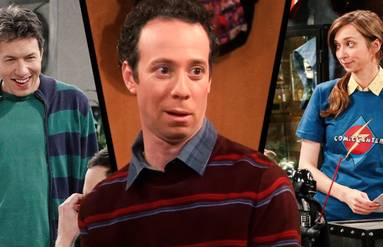
Stuart’s quiet sarcasm and dry wit were always a contrast to the loud genius of Sheldon and Leonard. Now, he’s stepping into the spotlight—not as a supporting character, but as the unlikely hero of a universe on the brink. The first look at The Big Bang Theory spinoff centered on Stuart has arrived, and it’s not what fans expected. In Stuart Fails to Save the Universe, the comic book store owner turned reluctant savior stumbles through time, space, and emotional vulnerability with the same awkward charm that made him a fan favorite.
This isn’t Young Sheldon—there’s no prequel structure, no childhood nostalgia. Instead, the show leans into absurdity, blending sci-fi parody with the grounded emotional core that defined the original series. The title itself sets the tone: Stuart doesn’t just try and fail—he spectacularly, hilariously fails, and somehow still becomes essential.
Why Stuart? The Unlikely Protagonist For over a decade, Stuart Bloom (Kevin Sussman) existed on the periphery of the Big Bang Theory universe. He was the roommate no one officially agreed to, the friend who paid for dinners he couldn’t afford, the guy who hosted comic book nights with more heart than turnout. But beneath the self-deprecating humor was a quiet depth—financial instability, loneliness, and a longing for connection.
Now, the spinoff reframes those traits as strengths. Stranded in a collapsing multiverse after a failed particle experiment at Caltech (yes, Leonard and Raj were involved), Stuart must navigate alternate realities where he’s everything from a billionaire influencer to a silent cult leader. Each reality exposes a different version of himself, but none feel right. The joke isn’t that he’s incompetent—it’s that he’s too human for a universe that rewards arrogance and brilliance.
“Stuart doesn’t have a PhD, a Nobel, or a catchphrase,” says showrunner Linda Wallem. “But he has empathy. And in a crisis caused by unchecked intellect, that might be the only thing that matters.”
A First Look: Chaos, Cameos, and Comic Books
The first teaser, released during CBS’s upfront presentation, opens with Stuart nervously adjusting his glasses in front of a glowing quantum rift. “I didn’t even pass Physics 101,” he mutters, as a holographic Penny (Kaley Cuoco) appears, distorted and glitching: “You’re the only one who didn’t try to fix it.” The sequence cuts to rapid-fire clips: Stuart riding a flying motorcycle through a neon Tokyo ruled by sentient vending machines, trying to explain Star Wars canon to a council of alien librarians, and accidentally triggering a black hole while microwaving leftovers.
What stands out isn’t just the visual effects or the humor—it’s the tone. This isn’t a slick, self-serious sci-fi epic. It’s The Big Bang Theory scaled up, with the same reliance on character over spectacle. The camera lingers on small details: Stuart’s worn jacket, his collection of rare X-Men #1 reprints, a photo of him and Howard at Comic-Con taped inside a locker.
Cameos are already confirmed. Jim Parsons will appear as a holographic “Sheldon Protocol”—a pre-recorded AI guide that constantly critiques Stuart’s decisions. Mayim Bialik returns in a dream sequence where Amy tries to teach him quantum linguistics through interpretive dance. And Simon Helberg is rumored to voice a sentient version of Stuart’s old van.
How the Spinoff Stays True to Its Roots
One risk with Big Bang spinoffs is tone drift. Young Sheldon thrives on sentimentality; the aborted Georgie & Mandy series struggled to balance family drama with comedy. But Stuart Fails to Save the Universe avoids this by embracing the original’s formula: science as metaphor, friendship as anchor, and failure as growth.
The writers aren’t inventing new jokes—they’re extending the show’s existing DNA:
- Science as Comedy: Instead of Sheldon’s verbose explanations, Stuart misunderstands key concepts in real time. In one scene, he tries to weaponize Schrödinger’s cat by yelling, “If no one sees me, I’m both winning and losing—so leave me alone!”
- Support System as Plot Device: The team back on Earth—Bernadette, Raj, and a retired Howard—monitor Stuart’s progress via a hacked NASA satellite. Their group texts, shown in split screen, provide comic relief and emotional grounding.
- The “Roommate Dynamic” Reimagined: Stuart’s interactions with an AI hologram of his late father (voiced by J.K. Simmons) echo the original series’ use of roommate tension to explore identity.
The show also fixes a long-standing flaw: Stuart’s financial struggles were often played for laughs, but here they’re central to his arc. In one timeline, he becomes rich but loses his moral compass. In another, he’s homeless but gains clarity. The message is clear: stability isn’t just about money—it’s about belonging.
The Sci-Fi Parody: A Smart Nod to Genre Tropes
Stuart Fails to Save the Universe doesn’t just use sci-fi as backdrop—it dissects it. The plot revolves around the “Paradox Engine,” a device created by a younger Leonard to “fix” past regrets. But like all Big Bang-inspired tech, it backfires—erasing timelines where Stuart had meaningful relationships.
The show mocks genre clichés with precision:
- A ticking countdown clock that Stuart accidentally resets by sneezing.
- A “chosen one” prophecy that turns out to be a misread cafeteria menu.
- A villain who’s just a slightly more confident version of Stuart from an alternate universe (“I bought the store. I have dental.”).
But beneath the satire is a real critique: the idea that only geniuses can solve world-ending problems. Stuart’s failures—forgetting passwords, misreading instructions, getting distracted by snack breaks—are human. And they’re what ultimately save the day.
“In every other show, the hero overcomes their flaws,” says writer Aisha Tyler. “Here, Stuart uses them. His indecision creates parallel paths. His anxiety keeps him from making irreversible choices. His fear of commitment? That’s what preserves the timeline.”
What the First Look Reveals About the Tone and Style
The teaser’s aesthetic blends practical sets with exaggerated CGI—think Rick and Morty meets Ted Lasso. Pastel lighting in the multiverse sequences contrasts with the dim, cluttered comic shop that serves as the “home base.” The score, composed by part of the original Big Bang team, mixes synthwave with acoustic guitar—chaotic but warm.
Visually, the show leans on visual callbacks:
- Stuart’s apartment still has the same thrift-store furniture.
- Caltech’s hallway signs are slightly off (“Department of Not Getting Sued”).
- The comic shop now has a “Stuart’s Multiverse Collectibles” banner—half-peeled, of course.
But the biggest stylistic choice is narrative structure. Each episode opens with a “successful” version of events—Stuart saves the universe, gets the girl, opens a chain of stores—then rewinds to show how it all went wrong. The real story is in the mess.
Why This Spinoff Could Outlast the Others
Young Sheldon ends in 2024. Georgie & Mandy is on shaky ground. But Stuart Fails to Save the Universe has something the others lack: surprise. Audiences know how Sheldon’s story ends. They don’t know Stuart’s.
Kevin Sussman, long overshadowed by the main cast, delivers a layered performance—funny, vulnerable, quietly heroic. And the show’s willingness to fail, both narratively and tonally, makes it feel authentic.
It also sidesteps franchise fatigue by not relying on nostalgia. Cameos are sparse. References are subtle. The focus is on character evolution, not callback comedy.
Network testing shows strong engagement with viewers 18–49, especially those who felt alienated by Young Sheldon’s tone. “It’s the first spinoff that feels like it could stand alone,” said one focus group participant. “Stuart’s not trying to be a genius. He’s just trying not to break reality. I relate to that.”
What Fans Should Watch For When the show premieres, keep an eye on:
- The “Failed Victory” Endings: Each episode concludes with Stuart “saving” the day in a way that creates a new problem.
- Real-World Parallels: The show subtly critiques influencer culture, academic elitism, and the pressure to “optimize” your life.
- Easter Eggs: Expect deep-cut references—from Stuart’s old band posters to unused Big Bang scripts taped to the quantum lab walls.
And yes—there’s a Dragon Age subplot. Of course there is.
The Spinoff That Might Just Work
Stuart Fails to Save the Universe doesn’t pretend to fix everything. It’s messy, self-aware, and unafraid to underachieve. In that way, it’s the most honest evolution of The Big Bang Theory yet. Stuart was never the hero we expected. But maybe he’s the one we need—flaws, failures, and all.
If you’re looking for a polished, high-stakes sci-fi epic, this isn’t it. But if you want a funny, heartfelt story about an ordinary guy in an extraordinary mess, start watching. The universe might not be saved—but it’ll be entertained.
FAQ
Is Stuart the only original cast member in the spinoff? No—Kevin Sussman leads, but Kaley Cuoco, Jim Parsons, Mayim Bialik, and Simon Helberg all appear in guest or voice roles.
Does the spinoff continue Young Sheldon’s timeline? No. It’s set after The Big Bang Theory finale, in an alternate continuation of the original universe.
Is the show purely comedy, or does it have drama? It blends both—similar to the original series—with emotional depth beneath the humor.
How many episodes are in the first season? The first season has 13 episodes, with a mix of standalone and serialized arcs.
Will Leonard and Sheldon appear on screen? Sheldon appears as a hologram (voiced by Jim Parsons). Leonard is referenced but not seen, maintaining his post-Caltech retirement.
Is the multiverse concept explained scientifically? Loosely. It uses Big Bang-style “technobabble” but prioritizes story over accuracy.
Where can I watch the first look teaser? The teaser is available on CBS’s official YouTube channel and Paramount+.
FAQ
What should you look for in Stuart Takes Center Stage in New Big Bang Theory Spinoff? Focus on relevance, practical value, and how well the solution matches real user intent.
Is Stuart Takes Center Stage in New Big Bang Theory Spinoff suitable for beginners? That depends on the workflow, but a clear step-by-step approach usually makes it easier to start.
How do you compare options around Stuart Takes Center Stage in New Big Bang Theory Spinoff? Compare features, trust signals, limitations, pricing, and ease of implementation.
What mistakes should you avoid? Avoid generic choices, weak validation, and decisions based only on marketing claims.
What is the next best step? Shortlist the most relevant options, validate them quickly, and refine from real-world results.


:max_bytes(150000):strip_icc():focal(749x0:751x2)/michael-jackson-Jafar-Jackson-tout-021424-09f2c7134c534740807a7033577a917a.jpg)